
-on-investment
We live in a old converted farmhouse and as you can imagine for a building from the late 19th century, insulation was more or less non-existent. So ever when we moved in it has been and ongoing effort to insulate the building step by step.
I started with the roof because with heat rising that should be the most effective first part you could tackle but a couple of years ago I decided to take on the wall between the residential area and the old stable. These sections together form a single building (we live in what in Dutch is called a 'langgevelboerderij', a long-façade farmhouse), but the stables are not heated at all, so the wall between the residential part and the stable is basically a large outside wall. Its surface area is about 25% of all outer walls and it is for the most part a single stone brick wall.
Now everybody (article in Dutch) always tells us that insulation is always a good investment, and with rising prices of energy that seems a no-brainer, but insulation also isn´t cheap, even if you do it yourself so save labour costs, so what I really wanted to know is if we could measure the effectiveness of the insulation.
Luckily I am a bit of a numbers person (if you couldn´t tell from the title of this blog), so for years I have a small weather station on my roof and I also monitor our electricity and gas use, so it is straight forward to plot the average monthly temperature as a function of energy use, both before and after insulating that wall.
But not so fast, things are never as straight forward as you might think.
For one we are not using a single energy source. Most of the rooms in our house are gas heated but some are heated by electric heaters, so we need to convert them to a common amount of energy. The average amount of energy contained in a cubic meter of gas in the Netherlands as delivered to households (so called 'low-caloric gas') is about 10 kWh/$m³$ link. So what we will actually need to use is the cubic meters of gas multiplied by 10, plus the number of kilowatt hours of electricity.
Another thing is, that although we could plot the daily energy consumption against the daily mean temperature, that would result in a very noisy graph, because daily temperature averages can fluctuate wildly in the Netherlands, especially in the spring. So in the plot I have shown the monthly numbers. Now of course not all months have the same number of days, so all numbers are normalized to a month of 31 days, i.e. the energy consumption for April for example is multiplied by 31/30.
Finally, at some time in spring, we stop heating altogether, but we still use electricity for hot water and household appliances. So the graph doesn´t include the months from May to August.
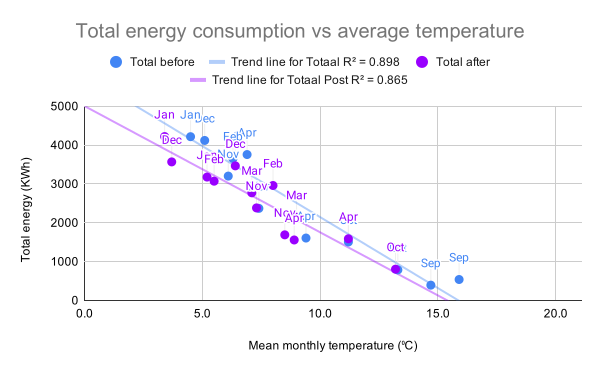
The result is still a bit noisy, but it looks like we have pretty clear trends.
What can we learn from this graph?
It looks like the trend line for 'after' is clearly lower than for 'before´, but we should not draw conclusions based on that, as the average temperature in a winter can vary from year to year. For example in the winter of 2021 (before the insulation) the average temperature from September to April was 8.2℃, while in the next year it was 8.4℃, and this highr outside temperature would show as a decrease in energy consumption even without that extra insulation.
What we could do is look at two months before and after with almost the same mean monthly temperature and compare the energy consumption. But although there are several such pairs present in the graph, the numbers are inconclusive, sometimes the energy consumption is even (slightly) higher in the 'after'situation! We look at possible explanations for that in a moment, but lets see what we can tell from the graph.
The important thing to look at here are the slopes of the trend lines. Both lines go down, as is expected, meaning that with increasing temperature the energy consumption decreases.
We also so see that the slope of the 'after' line is less than that of the before line. This means that the effect of temperature change is less, in other words, our insulation is working! The best way to look at this is to observe that going to the left the temperature gets colder, and we consume more energy, but this increase in consumption is less now that we have insulated that wall.
From those calculated trend lines we can get a few interesting numbers:
| Insulation | Consumption (kWh/℃) | Cutoff (℃) | Consumption @ 8℃ (kWh/mon) |
|---|---|---|---|
| before | -366 | 15.0 | 2877 |
| after | -325 | 14.5 | 2404 |
So for every degree that the mean monthly temperature drops, we consume about 40 kWh/month less.
And the temperature at which we stop heating altogether dropped by half a degree.
And although we should not compare individual points at distinct temperatures, we can take the average winter temperature of about 8℃ and see what the monthly consumption is for each of those lines. And that is about 475 kWh/month less after insulation or 20%.
What about noise?
If we look at graphs like this we should be wary of influences that may distort the results.
First we have measurement inaccuracies: The gas and electricity consumption numbers I retrieve directly from the gas and electricity meter and are both accurate to better than 1/1000th of a cubic meter and kWh respectively (according to the labels on the meters.) I consider this negligible for our purposes. My temperature measurements on my weather station are accurate to 0.1 ℃, so way less for the monthly average which is based measurements made every minute. Any systematic error (consistently too high or too low) would not affect the slope.
Then we have noise: Monthly temperatures can vary significantly, and energy consumption is dependent on more that just outside temperatures. Not only do we consume less energy if we happen to go on holiday, also things like solar irradiation plays a role: the same outside temperature will require less heating on a sunny day where lots of sunlight warms the rooms through the windows for example.
The quality of those trend lines are captured in a number often called $R²$. For both lines the are well above 0.85, which indicates that more than 85% of the variance in energy consumption is explained by the temperature. So I am pretty confident that the trend we observe is genuine.
On the back of an envelope
So what does this mean for our wallet? Well, we now know that during a six month winter period we save about 6 x 476 = 2876 kWh of energy. about 90% of this will be gas and the rest electricity, so 240 $m³$ gas and 476 kWh of electricity. At current prices of €1.37 and €0.25 this adds up to about €450,-/winter give or take.
Considering that I spent roughly € 900,- on materials (in 2021), we already recouped the investment.
Now your situation might be wildly different (we use a lot of gas because we have a large, old house, energy is really expensive in the Netherlands, and the price of insulation materials depends on lots of things), but I think it is save to say that an investment in insulation pays of pretty quickly.
Links
The spreadsheet with the numbers I used can be downloaded here. It also contains some extra notes to highlight the various subtilities.
Acknowledgements
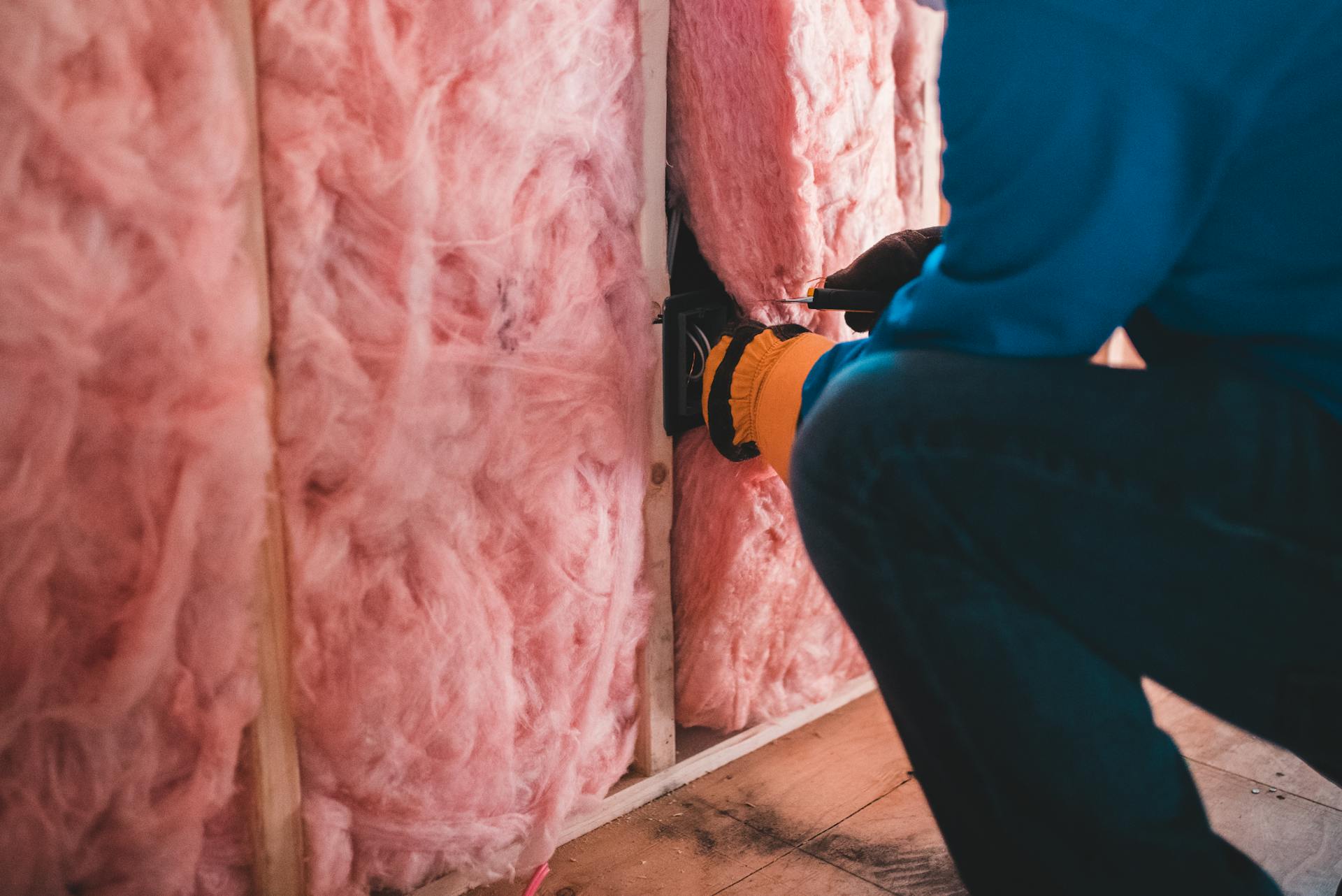
The image used in this article is an image by Erik Mclean.